
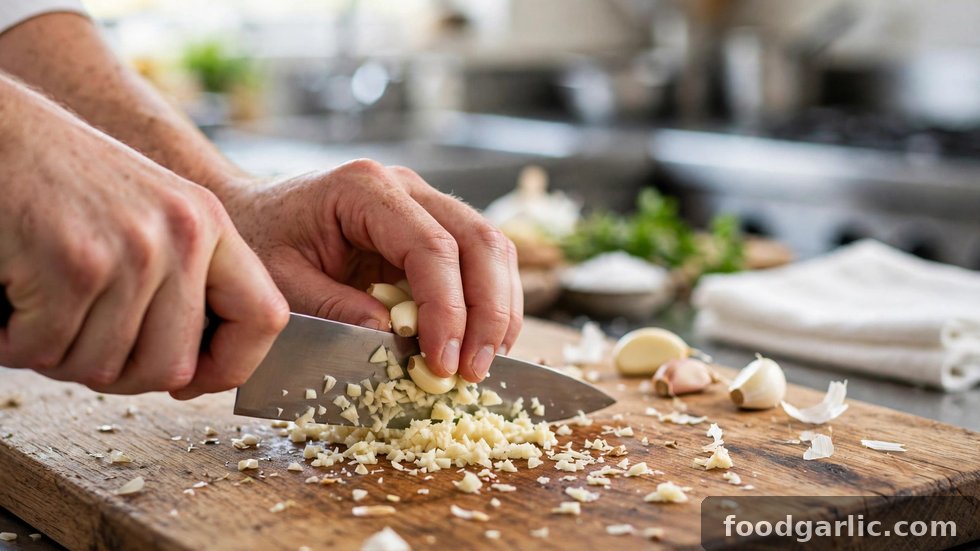
Watch a professional chef handle garlic and it looks like magic: cloves peeled in seconds, minced to a perfect even dice, grated into a paste without a single bitter chunk. The secret is not talent — it is technique.
In this guide, you will learn how to peel garlic in seconds, the proper way to mince, chop, and grate it, which cut suits which dish, and the knife skills that keep your fingers safe.
- The Tools You Need
- How to Peel Garlic Fast
- How to Mince Garlic
- Chop vs Slice: When to Use Each
- How to Grate Garlic
- Knife Safety and Care
- Frequently Asked Questions
The Tools You Need
You do not need gadgets. A chef’s knife (20 cm / 8 inches), a stable cutting board, and optionally a microplane grater cover every garlic task. A garlic press works but produces a harsher, more bitter flavor than knife work — chefs largely avoid it.
Keep a damp towel under your board so it does not slide. A sharp knife is safer than a dull one: it cuts cleanly instead of slipping, and it crushes fewer cell walls, which means less harshness in raw preparations.
How to Peel Garlic Fast
Forget picking at papery skins with your fingernails. Use the smash method: lay the flat side of your chef’s knife over a clove and give it a firm whack with the heel of your hand. The skin loosens and slips right off.
For a whole head, use the shake method: put the head in a metal bowl, cover with another bowl, and shake hard for 20 seconds. The cloves separate and most skins fall away. Trim the hard root end of each clove with the knife tip.
A third trick: microwave the head for 15–20 seconds. The skins puff away from the cloves and peel off effortlessly. Do not overdo it or the garlic starts to cook.
How to Mince Garlic
Mincing is the fine, even cut used for sauces, dressings, and sautés. Here is the professional method:
- Smash first: give the peeled clove a light smash to flatten it — this makes slicing stable and easy.
- Slice thin: make even thin slices across the clove, keeping your fingertips curled under in the claw grip.
- Cut strips: turn the slices 90 degrees and cut into thin strips.
- Cross-cut: cut across the strips to create a fine dice.
- Rock and chop: gather the pile, rest your free hand on the knife spine, and rock the blade through the pile until uniformly fine.
For a true paste, sprinkle the minced garlic with coarse salt and drag the flat of the blade across it repeatedly, pressing down. The salt acts as an abrasive and draws out moisture. Garlic paste melts into dressings and marinades with no chunks.
Chop vs Slice: When to Use Each
The cut you choose changes the flavor — more crushed cells means more pungency.
Rough chop
Quarter or roughly chop cloves for long braises, stocks, and roasts, where the garlic will soften completely and you want gentle background flavor. Large pieces also will not burn in a hot pan.
Thin slices
Sliced garlic is ideal for toasting in oil — think aglio e olio or garlic chips. Slices brown evenly and turn sweet and nutty. Keep them uniform so they cook at the same rate.
Fine mince
Use minced garlic when you want it to melt into a dish: sauces, stir-fries, dressings. Minced garlic burns fastest, so add it after other aromatics and keep the heat moderate.
How to Grate Garlic
A microplane turns a clove into a fluffy, intense purée in seconds — perfect for raw applications like vinaigrettes, dips, and marinades where you want garlic to disappear into the mixture.
Hold the microplane at an angle over a bowl and grate with short, even strokes, keeping fingertips well clear of the blades. Stop when you reach the last nub — or hold it with a fork for safety.
Note that grated garlic is the most pungent preparation because grating ruptures the most cells. Use about one-third less than you would minced garlic in raw dishes, then adjust to taste.
Knife Safety and Care
- Claw grip always: curl your fingertips under and guide the knife against your knuckles. The blade never goes past the knuckle plane.
- Cut away from your body and keep the board stable on a damp towel.
- Never catch a falling knife — step back and let it drop.
- Hone regularly with a honing steel; sharpen on a whetstone when honing no longer restores the edge.
- Wash and dry immediately — never leave a knife in a sink of water, and store it in a block, sheath, or magnetic strip.
These habits feel slow at first, then become automatic — and they are what separate confident home cooks from nervous ones.
Frequently Asked Questions
Should I use a garlic press or a knife?
A knife gives better flavor and texture control. Presses crush too many cells, producing a harsher, more bitter result, and they waste garlic stuck in the mechanism. Chefs overwhelmingly prefer the knife.
Why does my minced garlic turn bitter?
Bitterness usually comes from over-browning — minced garlic burns in under a minute over high heat. Cook it gently, add it late, and pull the pan off the heat as soon as it turns golden.
How do I get the garlic smell off my hands?
Rub your hands with lemon juice or a paste of baking soda and water, then wash with soap. Rubbing hands on stainless steel under running water also helps neutralize the sulfur compounds.
Can I mince garlic in advance?
Yes, but use it within a day or two — minced garlic loses flavor and can develop off tastes in storage. Keep it refrigerated in a sealed container, or freeze portions in oil in an ice-cube tray.