
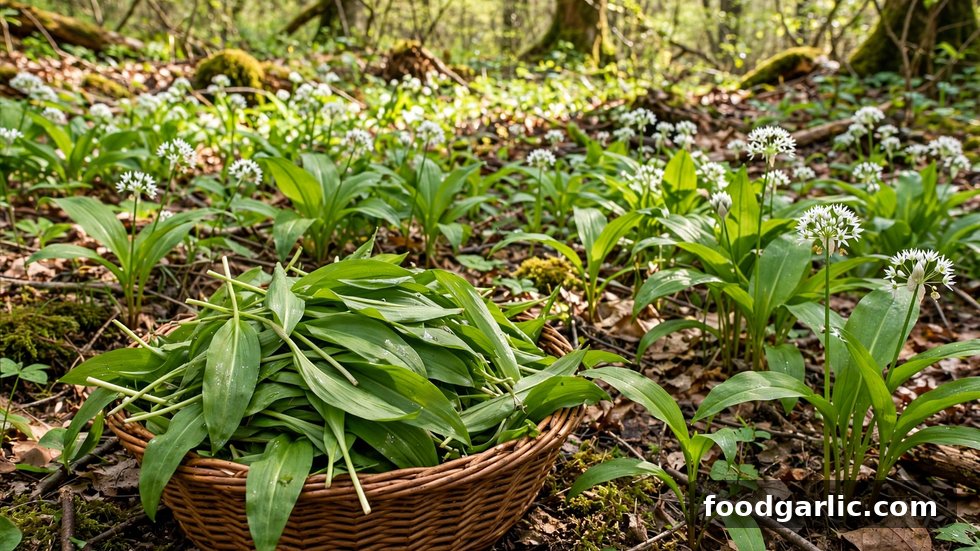
Every spring, woodland floors carpet themselves with broad green leaves that smell unmistakably of garlic. Wild garlic is a forager’s dream — free, abundant, and delicious. But picking the wrong plant can send you to the hospital.
In this guide, you will learn how to positively identify wild garlic, how to tell it apart from its dangerous lookalikes, the rules of safe and legal foraging, and how to harvest and use your find. By the end, you will forage with confidence instead of guesswork.
Table of Contents
- What Is Wild Garlic?
- How to Identify Wild Garlic with Certainty
- Dangerous Lookalikes: Lily of the Valley and Others
- Where and When to Find It
- Safe Foraging Rules and Harvesting Tips
- How to Use Wild Garlic in the Kitchen
- Frequently Asked Questions
What Is Wild Garlic?
Wild garlic (Allium ursinum), also called ramsons or bear’s garlic, is a wild relative of cultivated garlic and onions native to Europe and parts of Asia. Unlike bulb garlic, foragers harvest its broad, tender leaves, which carry a fresh, green garlic flavor — milder and more delicate than cloves.
It grows in large colonies in damp, shady woodlands, often near streams. In spring you can often smell a patch before you see it — that garlicky scent drifting through the trees.
How to Identify Wild Garlic with Certainty
Positive identification rests on several features together.
- The smell test (most important): crush a leaf between your fingers. Wild garlic releases a strong, unmistakable garlic-onion scent. Its dangerous lookalikes smell like nothing or like plain green leaves. If it does not smell like garlic, do not eat it.
- Leaf shape: broad, oval, pointed leaves, 2–5 cm wide, growing individually from the base on their own stalks — not in pairs.
- Leaf texture: smooth, soft, and slightly glossy on top with a matte underside.
- Growth habit: dense carpets of plants in damp shade; each plant sends up a single flowering stalk later in spring with a star-shaped white flower cluster.
- Season: leaves emerge in early spring (March–April in most regions); flowers appear in May–June.
The smell test is your gold standard. Every toxic lookalike fails it — which is exactly why you must perform it on every single plant you pick, not just the first one.
Dangerous Lookalikes: Lily of the Valley and Others
This section matters more than any recipe. Two common woodland plants resemble wild garlic closely enough to fool careless pickers — and both are toxic.
Lily of the Valley (Convallaria majalis) — Highly Poisonous
- Leaves look similar but grow in pairs from a single stem, while wild garlic leaves grow singly.
- Leaves are usually stiffer and more upright.
- No garlic smell when crushed — the decisive difference.
- Contains cardiac glycosides; ingestion can cause serious heart problems.
Autumn Crocus / Meadow Saffron (Colchicum autumnale) — Deadly
- Broad leaves emerge in spring and can resemble wild garlic at a glance.
- No garlic smell when crushed.
- Contains colchicine — potentially fatal even in small amounts.
Rule of thumb: if it does not smell strongly of garlic, it is not wild garlic. When in doubt, leave it out — no meal is worth the risk.
Where and When to Find It
- Habitat: ancient deciduous woodlands, damp shady banks, stream sides, and hedgerows with rich, moist soil.
- Timing: young tender leaves from March to April; flavor is best before flowering. Once white flowers appear (May–June), leaves become tougher and more bitter.
- Follow your nose: on a warm spring day, the garlic scent can carry dozens of meters through the woods.
Safe Foraging Rules and Harvesting Tips
- Know the law: in many countries, foraging on private land requires the landowner’s permission; some nature reserves prohibit picking entirely. Check local rules first.
- Take only leaves, sparingly: pick one or two leaves per plant and never strip a patch — the plant needs its leaves to survive. Never dig up the bulbs.
- Pick leaf by leaf: grabbing handfuls risks including a lookalike leaf. Inspect and smell each leaf individually.
- Avoid polluted spots: skip patches near busy roads, sprayed fields, or paths where dogs walk.
- Wash thoroughly: rinse leaves well at home to remove dirt, insects, and any contaminants.
- Start small: if it is your first time eating wild garlic, try a small amount to check for any personal sensitivity.
How to Use Wild Garlic in the Kitchen
Wild garlic’s delicate flavor shines in simple preparations. Use it like a cross between garlic and spinach.
- Wild garlic pesto: blend leaves with pine nuts (or walnuts), parmesan, olive oil, and lemon — the classic use.
- Butters and oils: chop finely into softened butter for an incredible steak or bread topping.
- Soups: wilt a big handful into potato or nettle soup at the end of cooking.
- Salads: young raw leaves add gentle garlic bite to spring salads.
- Preserving: pesto freezes well in ice cube trays; leaves can also be dried, though much flavor is lost.
Do not overcook it — add wild garlic at the end of cooking to preserve its fresh flavor, just as you would with fresh herbs.
Frequently Asked Questions
Is wild garlic the same as ramps?
They are close cousins but different species. Ramps (Allium tricoccum) are North American with narrower leaves and an edible bulb; wild garlic (Allium ursinum) is European/Asian with broader leaves, harvested mainly for its foliage.
Can I eat wild garlic flowers?
Yes — the white star-shaped flowers are edible and make a pretty, mildly garlicky garnish. Pick them sparingly so the patch can still set seed.
How can I be 100% sure I found wild garlic?
Crush a leaf: it must smell strongly of garlic. Combine that with single broad leaves growing from the base in a damp woodland in spring. If any feature does not match — or there is no garlic smell — do not eat it.
Can I grow wild garlic at home?
Yes, in a shady, damp corner with rich soil. Plant bulbs or seeds in autumn and be patient — it takes a couple of years to establish a good patch, but then it self-seeds freely.