
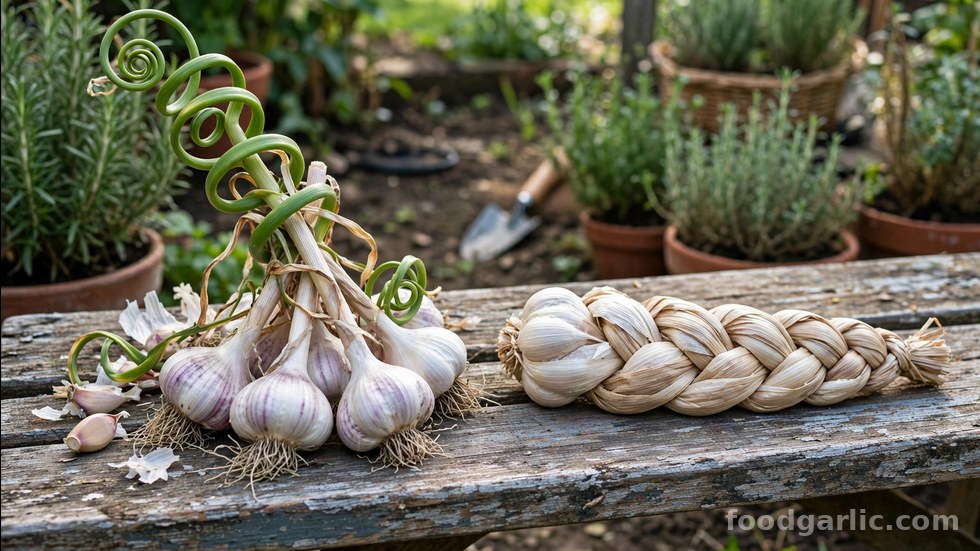
Gardeners staring at a seed garlic catalog for the first time usually hit the same wall: hardneck or softneck? The choice shapes everything — how your garlic tastes, whether you get those curly scapes to cook with, how long your bulbs store, and even whether your climate will cooperate. Pick wrong and you can lose a whole season. Here is a clear breakdown of both types so you can plant with confidence this fall.
Table of Contents
- Hardneck vs Softneck: The Basic Difference
- Flavor Comparison
- Scapes: The Hardneck Bonus
- Climate and Growing Conditions
- Bulb Size and Clove Count
- Storage Life
- Top Varieties of Each Type
- Which Should You Choose?
- FAQs
Hardneck vs Softneck: The Basic Difference
The names describe the flower stalk. Hardneck garlic (Allium sativum var. ophioscorodon) produces a stiff, upright flower stalk — the scape — that grows straight through the center of the bulb. Softneck garlic (Allium sativum var. sativum) produces no central stalk; its neck stays soft and flexible, which is why you can braid it.
That single anatomical difference drives everything else. Hardneck bulbs form a ring of large cloves around the central stalk, like slices of an orange. Softneck bulbs pack multiple layers of cloves of varying sizes around the center.
Flavor Comparison
Most chefs agree: hardnecks generally deliver more complex, intense flavor. They tend to have sharper, richer, and more nuanced profiles — some sweet, some musky, some fiery — and the differences between varieties are easy to taste.
Softnecks are milder and more uniform, with a pleasant garlicky heat that does not overwhelm. That consistency is exactly why grocery stores sell almost exclusively softneck — it suits every recipe and every palate.
- Hardneck: bold, complex, variable between varieties; great for raw applications like pesto, aioli, and salad dressings where flavor shines.
- Softneck: steady, all-purpose flavor; the reliable kitchen workhorse for roasting, sautéing, and long-cooked dishes.
You can plant a mix so you can compare flavors side by side in your own kitchen.
Scapes: The Hardneck Bonus
Only hardnecks produce garlic scapes — the tender, curly flower stalks that emerge in late spring. Scapes are a delicacy: mild, sweet, and perfect grilled, sautéed, or blended into pesto.
Removing scapes is also good garden practice. Snipping the scape directs the plant’s energy into bulb growth, sizing bulbs up noticeably — some growers report 20 to 30 percent larger bulbs when scapes are removed promptly.
- Harvest scapes when they curl one full loop — tender and at peak flavor.
- Snap or cut the stalk just above the top leaves.
- Use within a week, or freeze/chop for later.
Softneck growers skip this chore entirely — no scapes, no snipping.
Climate and Growing Conditions
This is the deciding factor for many gardeners. Hardnecks need cold winters. They require weeks of temperatures below freezing (a process called vernalization) to divide into distinct cloves. In warm climates, hardnecks may produce a single undivided round, or nothing at all.
Softnecks are far more adaptable. They thrive in mild winters and warm climates where hardnecks fail, making them the standard choice in the southern US, Mediterranean regions, and subtropical zones.
- Cold climates (zones 3–6): hardnecks thrive; softnecks survive but underperform.
- Moderate climates (zones 6–7): both work; plant each in suitable microclimates.
- Warm climates (zones 8–10): softnecks are the safe bet; hardnecks need artificial chilling or a cold microclimate.
Both types are planted in fall, 4–6 weeks before the ground freezes, and harvested the following summer.
Bulb Size and Clove Count
Hardnecks produce fewer, larger cloves — typically 4 to 12 per bulb, arranged in a single ring. The large cloves are easier to peel, which cooks appreciate. Purple Stripe types often grow smaller bulbs with richer flavor; Porcelain types grow the biggest bulbs of all.
Softnecks produce more, smaller cloves — anywhere from 8 to 20-plus per bulb in layered rows. More peeling work, but more total cloves per bulb for planting stock.
Interesting comparison: elephant garlic vs regular garlic shows how dramatically bulb size can vary across the broader garlic family.
Storage Life
Here softneck wins decisively. Softneck garlic stores 8 to 12 months — cool, dry, well ventilated. Hardneck keeps 4 to 6 months at best; its open neck dries out faster. The practical fix: use hardnecks first and keep softnecks for the long haul.
- Store at 60–65°F (room temperature) with airflow — never refrigerate storing bulbs.
- Mesh bags or open baskets beat plastic bags.
- Braid softnecks for beautiful, functional kitchen storage.
Top Varieties of Each Type
Hardneck Varieties
- Rocambole: the flavor king — rich, complex, easy-peeling cloves. Poor storage (4–5 months), so eat it first.
- Purple Stripe: striking purple-striped wrappers, intense flavor, excellent for baking. ‘Chesnok Red’ is a favorite for roasting.
- Porcelain: huge bulbs, tall scapes, hot raw flavor that mellows beautifully when cooked.
Softneck Varieties
- Artichoke: the most common softneck — large bulbs, mild flavor, excellent storage. ‘Inchelium Red’ is a top pick.
- Silverskin: the longest-keeping garlic of all (up to 12 months), with tight white wrappers.
- Creole: a warm-climate type with rose-colored cloves and sweet heat. ‘Creole Red’ excels in the South.
Which Should You Choose?
Match the variety to your region and your goal:
- Cold climate + flavor-first: plant mostly hardneck (Rocambole, Purple Stripe).
- Warm climate: plant softneck (Artichoke, Silverskin, Creole) — hardnecks will disappoint.
- Long storage matters most: lean softneck; keep a small hardneck patch for eating first.
- Love scapes: hardneck only.
- Not sure: split your bed 50/50 and let your taste buds decide next year.
Whatever you pick, the basics in our growing garlic at home guide apply to both types. If you are curious about garlic beyond the cultivated kinds, our guide to wild garlic identification covers the foraging side of the allium world.
Frequently Asked Questions
Can I grow hardneck garlic in a warm climate?
It is difficult. Hardnecks need several weeks of cold to form cloves. Gardeners in zones 8+ can try pre-chilling cloves in the refrigerator for 6–8 weeks before planting, but results are inconsistent — softnecks are the reliable choice in warm regions.
Which type is better for braiding?
Softneck only. The flexible neck weaves into braids beautifully. Hardneck stalks are rigid and will snap if you try to braid them.
Do hardnecks and softnecks cross-pollinate?
Garlic rarely flowers successfully and is propagated by planting cloves, not seed. You can plant both types side by side with no risk of crossing.
Can I plant grocery store garlic?
You can, but most store garlic is a generic softneck treated with sprout inhibitors and possibly carrying disease. Certified seed garlic from a grower gives far better results and lets you choose named varieties.
How do I tell them apart in the store?
Look at the top of the bulb: a stiff central stalk sticking through the cloves means hardneck; a soft, flat-topped neck means softneck. Most supermarket garlic is softneck.